Divining with the Pendulum

Most people prefer to use a pendulum with the same hand they write with. Personally, I don’t think it really matters which hand you use. I happen to be left-handed, but my own pendulum seems to work better when I use it with my right hand. You may wish to practice with both hands and see which works better for you. If you are sitting down, rest your elbow on a table and hold the chain of your pendulum between your thumb and first finger. The palm of your hand should be facing downward, and the pendulum should be hanging about a foot in front of you. If you are standing, the best position is to have an angle of 90 degrees at the elbow, so that your forearm is parallel to the ground.

Getting Started

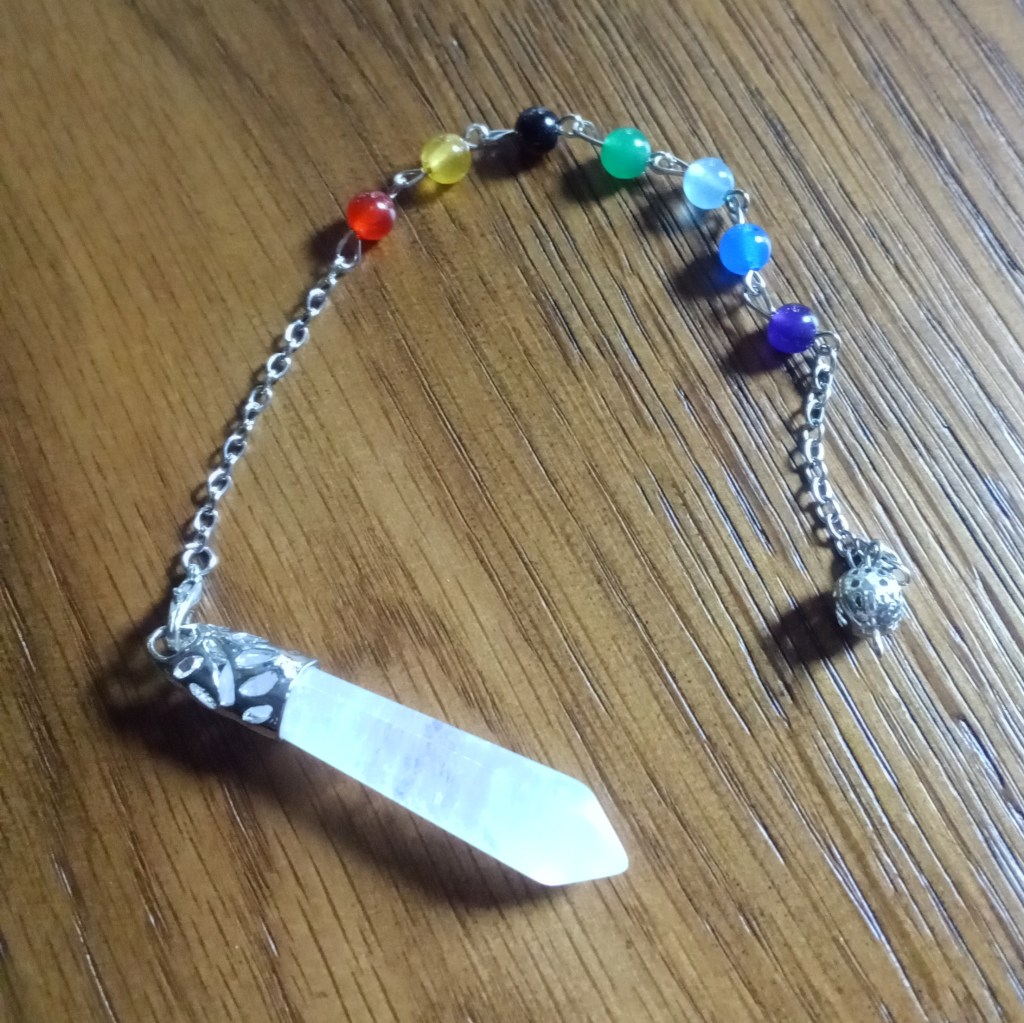
Hold the pendulum in front of you and allow it to swing in a clockwise motion. Then swing the pendulum gently back and forth to become familiar with the movement. Allow the pendulum to swing in different directions. Deliberately swing the pendulum in gentle circles. When the pendulum is still, ask it which movement indicates a “Yes” or ‘positive’ response. It may take time for the pendulum to move. Be patient. Then ask it to indicate a “No” or ‘negative’ response. Many people use the pendulum to help locate lost objects, determine a best course of action or to answer “yes or no” questions. There are helpful pendulum charts, cloths and boards, but these are not necessary for the pendulum to work. Preferred pendulums are made of wood or from crystals and stones. Some believe pendulums made of conductor materials like silver, copper or brass should not be used. Those made of quartz crystal seem to be most effective, as this stone is easily “programmed” with intention and stores magical energy quite well. My own pendulum is made of a quartz that seems to glow in the light, and I am always astounded by it’s accuracy. When you find a pendulum you like, it is important that you do not treat it as a trivial object. Regard it as a sacred, divine tool. When not using it, keep it in a pouch made of natural fiber, and do not allow anyone else to touch or use it. Your pendulum will attune to your energy, so you must keep it safe and away from the hands of others.

How It Works

The unconscious, involuntary movements of the hand holding the pendulum cause it to move. The subconscious mind of the person holding the pendulum causes the muscles to react unconsciously. The pendulum amplifies responses that would otherwise be too small to notice. Consequently, the answers are coming from your connection to the Divine Mind. The pendulum gives us access to our subconscious minds. The subconscious mind accesses the Divine Mind that contains all knowledge. The pendulum accesses our subconscious minds, which in turn taps into the Divine Mind, and the pendulum gives us the answer we seek. When using the pendulum, it is best to be in a meditative Alpha state. This will make it easier to access the subconscious. Watch for the gentle “pull” of the pendulum guiding you to the answer you seek.

Practice

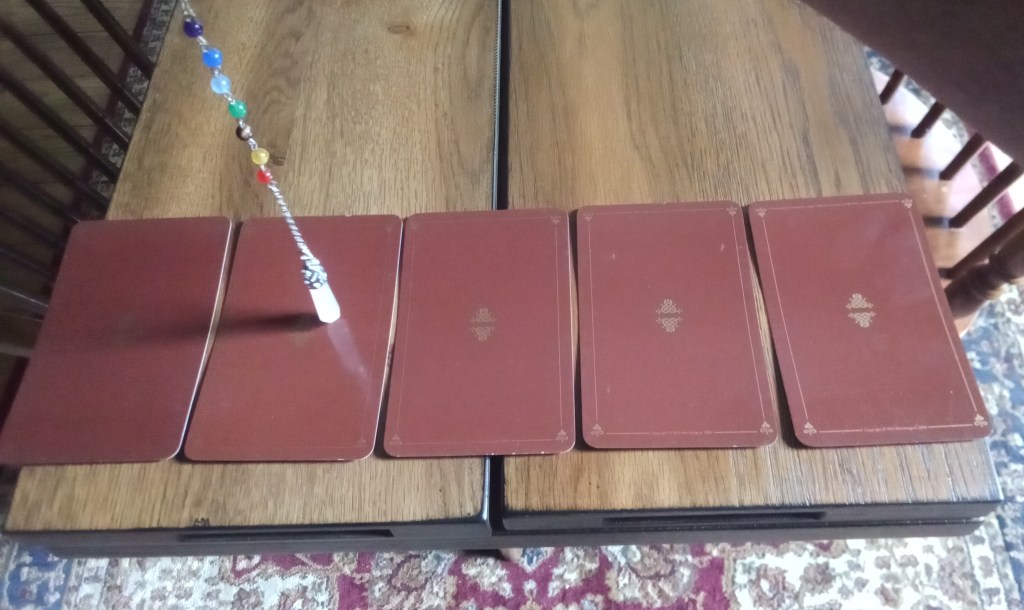
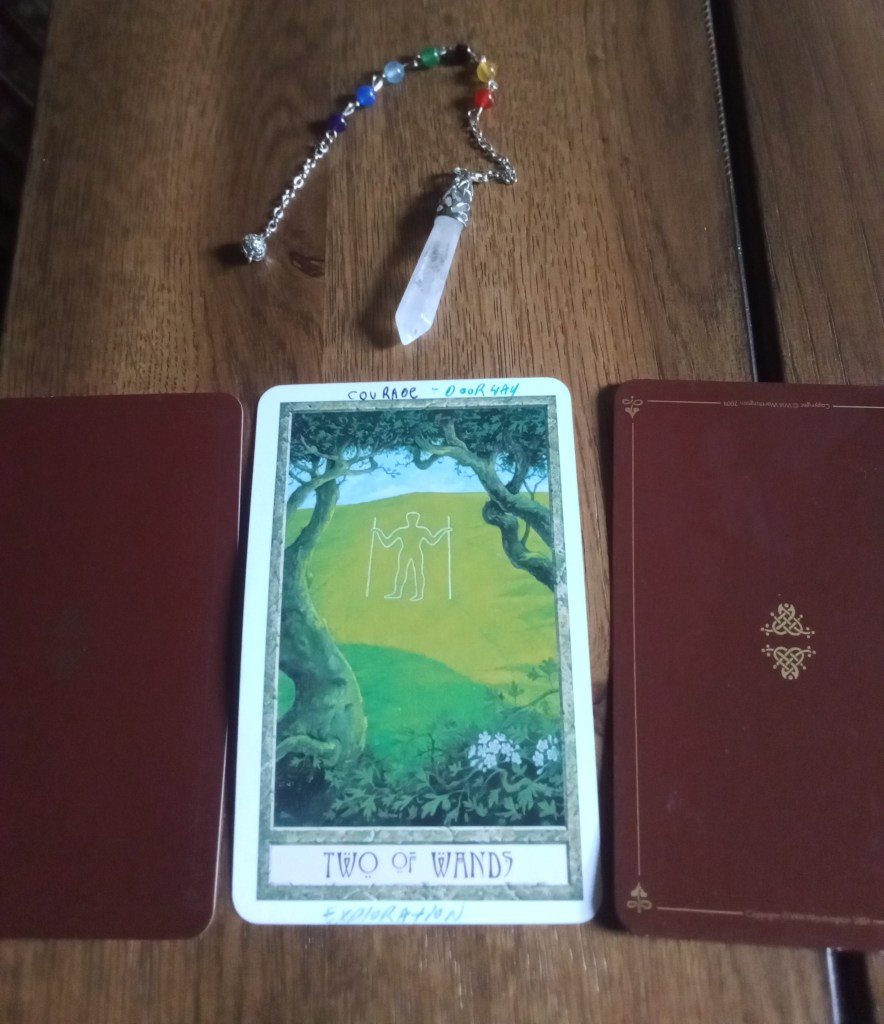
One of the best ways to develop your skills with the pendulum is with the use of tarot cards. Choose five random cards from any tarot deck. Look at them to see what they are and write them down. Turn all five cards face down, and then close your eyes and shuffle them so that you don’t know which card is which. Place them all face down in front of you. You will be asking the pendulum to locate each specific card, one at a time. Let’s say you know that one of the five cards is the Two of Wands. Hover the pendulum a few inches above each card and ask “Is this card the Two of Wands?

This is where it gets tricky. It is important to take your time and not to rush this process. Patience is necessary here. It took me awhile to realize what was happening, and I was pleasantly shocked when I first saw it.

Hover your pendulum still (in other words, don’t move it in circles or anything like that), over each card for about 10 to 20 seconds. Keep your focus on the card you’re looking for, in this case, the Two of Wands. Watch the pendulum very closely for subtle movements. There will be no movement at all, or very little movement over the incorrect cards. As you approach the correct card, the pendulum may start to vibrate or move in small circles. It sometimes does this over the incorrect cards as well, but movements over the correct card will be more defined. Continue hovering the pendulum a few inches above each card while observing any movement. The pendulum needs to “read” each card before it can choose the one you’re looking for. Go from left to right, then right to left, and continue this until you begin to see a pattern. As you move from one card to the next, you will eventually begin to see the pendulum being pulled slightly to the left or the right. It will appear as if an invisible finger is gently directing it toward the correct card. This is exactly how it looks to me. The first time I did this experiment, the pendulum correctly identified all five cards. Since then, my pendulum has become one of my most powerful divinatory tools.
Healing with the Pendulum

Ask the person seeking healing to lie down, then hold the pendulum about 1 foot above the body, starting at the head. Scan the entire body from head to feet, while watching the movements of the pendulum for any irregularities. Ask the pendulum to indicate areas that need healing. There will be a slight pull of the pendulum toward unhealthy areas. Place the hand not holding the pendulum over these areas and visualize white light coming out of your hand and into the person’s body.

To send healing to someone who is not present, you will need a pendulum and two beeswax candles placed side by side about a foot apart. The candle on the left represents you, the candle on the right represents the person you wish to send healing to. Bring yourself into a meditative alpha state and visualize the other person as clearly as you can in your mind’s eye. Swing the pendulum back and forth slowly from one candle to the other in a continuous motion. Visualize healing being carried from the candle on the left (You) to the candle on the right (the other person). Do this until you intuitively feel the process is complete. Then, stop the swinging of the pendulum with the other hand. Blow out the left candle, then the right. Picture the other person fully restored to health.

Divination

The word ‘divination’ is derived from the word ‘divine’. This indicates that the practice of divination is empowered by a divine source. When we practice any form of divination, we are essentially calling on the divine to assist us through the chosen medium (such as a pendulum, crystal ball or tarot deck). In this light, it is not far-fetched that the pendulum is being guided by an unseen force.
Celebrating Lughnasadh

Of all the Celtic Gods, Lugh was one of the most beloved. He was the “Shining One”, according to some versions, a son of Mannanan MacLir, and skilled in all the arts. He was called Lugh Lamfada (“of the long arm”) and Samildanach (meaning “skilled in all the arts”). He was a beautiful child with golden hair like the sun. He is portrayed as handsome and youthful. Tailtiu was the Goddess of Sovereignty, the queen of the Fir Bolg and his foster mother. She lived on the Hill of Tara, where she taught Lugh, helping him to learn about history, poetry, music and everything he would need to learn to be a well-rounded and powerful leader. When Lugh became an adult, he tried to enter the court of King Nuada (NOOa-ha). Just as everyone was sitting down to feast. The gatekeeper challenged Lugh to tell his name and of his skill. For no one without a special art or skill may enter Tara.
“I am a smith”, said Lugh.
“We already have a smith”, said the gatekeeper. “Why would we need another?”
“I am a warrior”, said Lugh.
“We have no need of one”, laughed the gatekeeper, “Ogma is our champion”.
“I am a harpist”, said Lugh.
“We have a harpist”, said the gatekeeper, “and quite a good one at that”.
“I am a hero” said Lugh, “renowned for skillfulness rather than mere strength”.
“All of the gods are heroes”, the porter shook his head at Lughs persistence.
“I am a poet and a tale-teller from the land of apples, rich in swans & yew trees” said Lugh.
“Taliesin is the greatest poet in Ireland”, said the gatekeeper, “Why would we need you?”
“I am a cup-bearer”, said Lugh. “We already have nine of them”, said the porter.
“I am a worker in bronze”, said Lugh.

“We have no need of you. We already have a worker in bronze”, said the gatekeeper.
“I am an historian, a doctor, and a magician”, Lugh told him.
The gatekeeper responded, “We already have men skilled in all these things. I dont see why we would need your services”.
“But do you have anyone who is master of all of these crafts at once?” Lugh asked.
The gatekeeper had to admit that they did not, and invited him in. Lugh entered and sat down upon a chair kept for the wisest man. The champion, Ogma was showing off his strength by pushing around a large flagstone. The stone, as huge as it was, was only a portion broken from a still greater rock. Lugh picked it up in his hands and put it back in its place. The king asked him to play the harp. Lugh played the sleep-tune and the king and all his court fell asleep until the same time the next day. Next Lugh played a lamenting tune and they all wept, and then he played a song which brought them joy. When the king saw all these talents he gave the throne to Lugh for thirteen days. Lugh became the leader of the Tuatha De Danann.
Lugh’s foster mother Tailtiu died of exhaustion after working hard to clear the lands of Ireland for farming. Lugh was so fond of her that he held a festival in her memory. People would gather around bonfires, sharing stories and food. They would compete in contests of skill and strength. Lugh invented ball games and horse races for all to play. It was said that as long as these traditions continued there would be corn and milk in every house, peace and fine weather for the feast. Tailtiu became the Goddess of the Harvest, like Ceres to the Romans, and Corn Mother to Native Americans. She looked on as her children played and feasted. The festival of Lughnasadh is still celebrated in memory of Lugh the Sun King, and his beloved Foster Mother and Teacher; Tailtiu.

Lughnasadh (Festival of Lugh) is the first of three harvest festivals, traditionally celebrated on August 1st. In Irish Gaelic, and a slightly different spelling, Lunasa is the word for August. In the Christianized version, it is called Lammas (meaning Loaf-Mass or the Feast of Bread, at which time the first loaves of the season were blessed by the church). The hot days of August are now upon us, much of the earth is dry and parched, but we still know that the bright reds and yellows of the harvest season are just around the corner. Apples are beginning to ripen in the trees, our summer vegetables have been picked, corn is tall and green, waiting for us to come gather the bounty of the crop fields. Now is the time to begin enjoying the fruits of our labors, both on the table and in our lives. We honor this holiday to celebrate the first harvest, and the Celtic God Lugh, the sacrificed King of the Grain. Grain has held a place of importance in civilization back nearly to the beginning of time. Grain became associated with the cycle of death and rebirth. In early Ireland, it was a bad idea to harvest your grain any time before Lughnasadh — it meant that the previous year’s harvest had run out early, and that was a serious failing in agricultural communities. However, on August 1, the first sheafs of grain were cut by the farmer, and by nightfall his wife had made the first loaves of bread of the season.

Lughnasadh is a day of honoring Lugh, the Celtic craftsman god. He is a god of many skills, and was honored in various aspects by societies both in the British Isles and in Europe. Lughnasadh is still celebrated in many parts of the world today, and his influence appears in the names of several European towns. In our modern world, it’s often easy to forget the trials and tribulations our ancestors had to endure. For us, if we need a loaf of bread, we simply drive over to the local grocery store and buy a few bags of prepackaged bread. If we run out, it’s no big deal, we just go and get more. When our ancestors lived, hundreds and thousands of years ago, the harvesting and processing of grain was crucial. We honor our ancestors and the hard work they had to do in order to survive. This is a good time to give thanks for the abundance we have in our lives, and to be grateful for the food on our tables. As we enjoy nature’s abundance, what can we give in return? Lughnasadh is a time of transformation, of rebirth and new beginnings. Because of its association with Lugh, The Many-Skilled One, Lughnasadh is also a time to celebrate talents, skills and craftsmanship. What are your talents and gifts? How can you share those talents and gifts with others? Now is the time of year to work on developing your own talents. Learn a new craft, or get better at an old one. Start a creative project, write a book, play a musical instrument, sing a song, dance, paint. Learn a new magical skill, such as the reading of runes or the making of candles. Whatever you choose to do, this is the right season for thankfulness and sharing.

Re-Awakening The Witch

The practice of witchcraft has undergone many changes throughout the years. Some of these changes have been good and some of them not so good. Some changes are being touted as “modern ideas”, while older practices are regarded as “outdated” or “no longer relevant”. The ways of the Witch have become sanitized and diluted to make them more acceptable to the masses. Witches are not feared as they once were. The witch is more than just someone who wears pretty crystals and lights scented candles, while chanting healing words under a full moon, with New Age music playing in the background. There is a place for this, but we must not become too attached to a romanticized image. A witch can make someone’s life easier. A witch can also make someone’s life very unpleasant, and sometimes it is necessary. We are not docile and harmless. For the witch, Light and Dark are two sides of the same coin. In the old days, you wanted to be on the witch’s good side. To provoke a witch could be quite dangerous. For a very long time, witches were respected and feared in equal measure. Then along came the Wiccan Rede. The disclaimer “Do what you will and harm none” made it socially acceptable to be a witch, as in “I’m a witch but it’s okay because I follow the Rede”. This generated the false notion that “good” witches follow the Rede and “bad” ones do not. Before Gerald Gardner and Doreen Valiente, there was no Wiccan Rede, no Threefold Law. Witches were simply witches, living by their own ethical codes and moral standards. They were sovereign, each living according to their own rules. This is the way of the Old Ways Witch. It is not because of the Rede that the innocent are not harmed. The reason the innocent are not harmed is because they are innocent. The other side of this coin is that those who provoke a witch can no longer claim innocence. Back us into a corner and we come out fighting. If someone has a knife to your throat, throwing “love and light” at them isn’t going to save you. You will do what is necessary to protect yourself. There are times when banishings, bindings and curses are absolutely called for, such as when dealing with a stalker or someone seeking to harm your family. There are also times when they are definately NOT called for, such as when an insecure High Priestess chooses to banish from the community anyone who disagrees with her. I do not completely agree with the idea of doing something to make their lives better so they leave you alone. It’s a bit like that ridiculous Bible verse that says “bless those who persecute you”. Sure. Bless them so they can persecute others. Sorry, NO. The witch must remain someone who is both respected and feared.

The Witch and Sovereignty

As a witch, it is your right be sovereign. You develop your own practices, rituals and spells, using methods that work best for you. The way you practice witchcraft is not subject to anyone’s approval or permission. There are far too many people on social media trying to police how others practice. It is childish and ridiculous. I have seen both extremes. There are those who say you’re not “authorized” to engage in certain magical practices unless you belong to a particular culture or tradition. There are casual, lazy types who spout such nonsense as “you don’t need anything, you have all you need within you” and “the only important thing is intention”. They make witchcraft seem so simple, so easy, as if you could cast spells while you’re eating a cheeseburger or watching a movie and you don’t even have to get up from the couch. Witchcraft is not as simplified as people try to make it seem.

The Witch and The Night

The most powerful witches make a connection with the energies of the night. When the moon rises, and many begin preparing for sleep, this is when the abilities of the witch are strongest. It is during the night-time hours, particularly between 3am-5am, when astral interference is at it’s lowest ebb. The chaotic energies generated by social interactions, cellphones, traffic and other anxieties of the day have ceased, if only for a short time. During this time the spells cast by a witch can flow unhindered through the ether. The powers of psychic suggestion and magical intention reach their destinations with less impedance. The night has a special kinship with the word occult, which simply means hidden. In the same way that the night hides and obscures, occult wisdom is hidden from those without the awareness to comprehend it. Witches are the hidden ones. They do not fear the night, for they wear it as a cloak. Witches have long been associated with the night, as they themselves are creatures of the night.

The night is a conscious force with it’s own tangible energy. The darkness of Night is the realm of potentiality, the nothingness from which all things emerge. All things are birthed out of darkness, from the plants that rise from beneath the earth to the child that emerges from the darkness of the womb. To tap into this force, simply wait until the midnight hour has passed and turn off all lights. The only light should come from natural sources, such as moonlight or candlelight. Open a window, close your eyes and take several deep breaths until you reach a meditative state. Isolate that sound of night-time stillness. This can be difficult to do if you live in a metropolitan area, with constant sirens, car horns and people shouting in the street. If this is the case, treat it as an exercise in concentration and focus. If you live in a rural or wooded area, it will be much easier. Tap into the indefinable energy of the night.

When we look up into the night sky and gaze upon the moon goddess in all of her fullness, we can feel a sense of nurturing and maternal love. Old witchcraft lore tells us that the moon has a strong link with the spirits of the dead. Communication with the spirit world can take place with much less restriction during the late night hours. Those who interact with spirit guides and the departed dead find that their communications are much clearer and easier to interpret during the dark of the night. Divination tools such as the tarot and the crystal ball seem to be particularly enhanced in the night-time hours.

The Witch and the Liminal

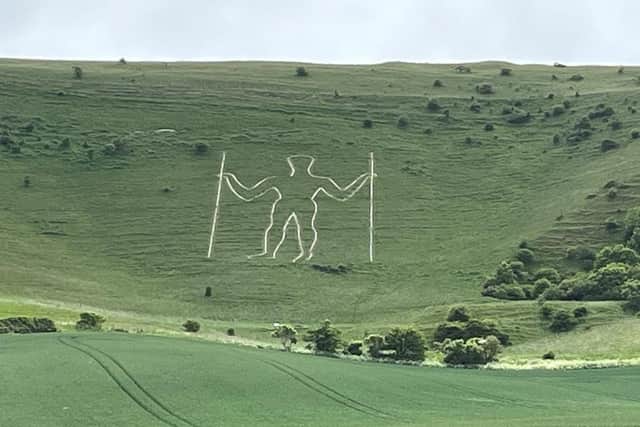
Many modern witches seem to have forgotten that we are meant to “walk between the worlds” of the seen and the unseen, the living and the dead, the magical and the mundane. A witch of the Old Ways communes with many spirits, not only of the departed dead, but also the spirits of plants, stones, trees, bodies of water, animals and planetary forces. Like the Long Man of Wilmington, we stand in the doorway that separates this world and the Otherworld.

Long Man of Wilmington, East Sussex, England

The Witch and Blood, Bone and Shadow

A truly powerful witch does not shy away from the use of blood (usually their own) in rituals and spells. Our blood contains the essence of our ancestors. Blackthorn Witches place three drops of their own blood into their wands. This infuses the wand with their life force and forges a stronger bond. Blood is a powerful addition to spells. There is nothing evil or malevolent about using blood in witchcraft. It produces quick results and connects us to those who came before us. Many witches also frequently use bones, particularly animal bones and skulls. This helps us connect with animal guides and partake of their wisdom. Many will also use artificial human skulls as a tool to contact the dead, as bones contain ancestral DNA. Working with ‘shadow’ in witchcraft not only refers to the Shadow Self, those things we keep hidden from others, but also to the retrieval of hidden wisdom. The late Raven Grimassi has written some very informative works on this topic. Blood, Bone and Shadow are also linked to three colors of traditional witchcraft: Red, White and Black. You may have seen traditional witches wearing cords made from these colors. Red is linked to Blood, White to Bone and Black to Shadow.

Re-Awakening The Witch

These concepts and ideas are not often seen in the lives of many so-called “modern” witches, those who view witchcraft as a hobby or something fun to do on the weekend. Witchcraft is not all love and light, incense and candles. Those who choose to call themselves “witch” must also embrace the necessary darkness that it holds. It is equally important that others see us not only as someone who can help them, but also someone who is not to be provoked without consequence. The time has come to re-awaken the witch and return to the Old Ways.

The Magic of Moonstone

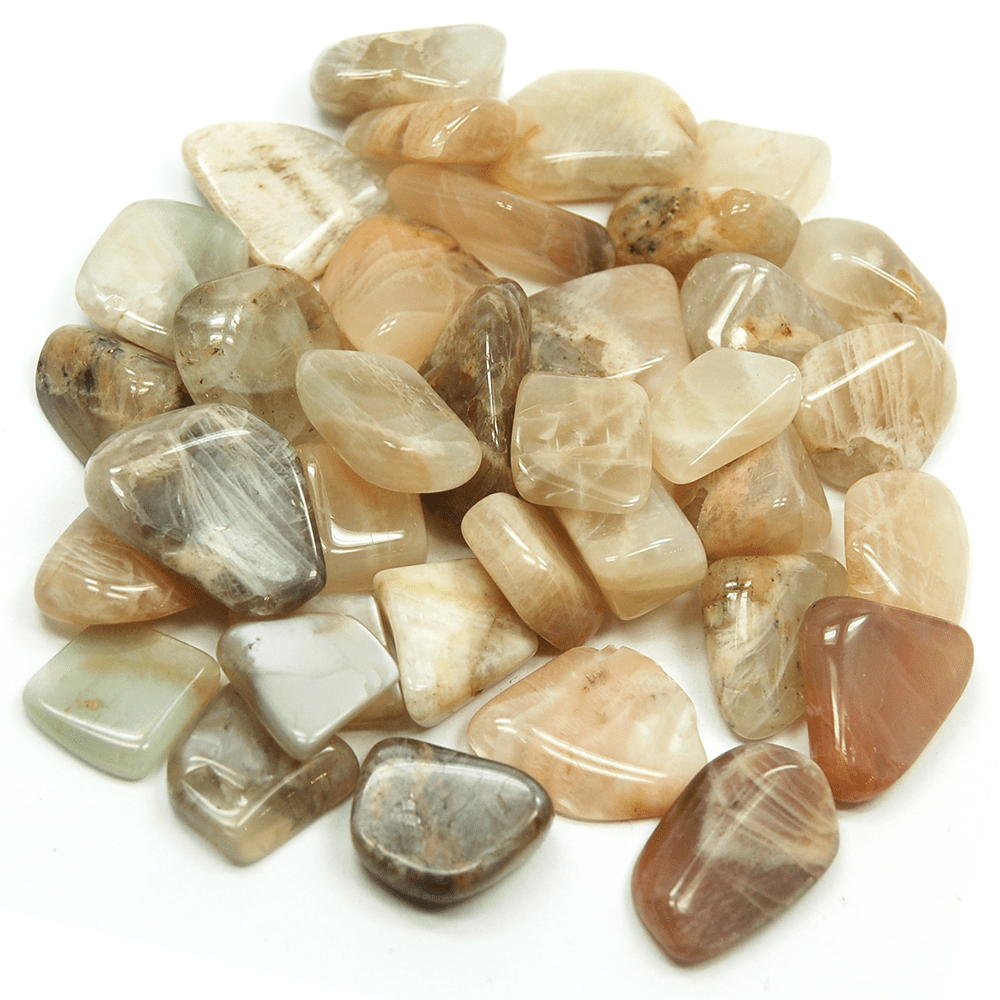
Moonstone is a natural stone, formed from the mineral feldspar. The inter-growth of different types of feldspar during gem formation are the source of the moonstone’s shimmer, also known as adularescence. The finest moonstones are found mainly in Sri Lanka and Southern India. Moonstone is linked, of course, to the Moon and to the element of Water. It is used to call upon lunar deities, particularly the Moon Goddess of Old Ways Witchcraft. It is useful with all forms of divination. The powers of the Moonstone help to enhance psychic and intuitive abilities, astral projection, lucid dreaming and shamanic journey practices. It can be in blue, white, peach, pink, rainbow or tan colors. Moonstone helps to stabilize emotional states, and helps to release stress and tension. It helps to lessen mood swings and prevent over-reacting to situations and pressures. Magical practitioners believe it’s powers increase as the moon is Waxing to Full. Moonstone is favored by cats, children and those who are traveling. It is believed to help the growth of plants, and increase the flow of beneficial energies during magical ritual. Moonstone has long been known for its calming, soothing qualities on the emotional body. Its energy is balancing and healing, assisting in the mastery of emotions by bringing them under the control of Higher Will, rather than expressing or repressing them. It also helps identify emotional patterns that are stored in the subconscious, and serves as a guardian to contain explosive passions, and to stimulate confidence and composure. It has a mystical quality that helps witches tap into the subconscious and access the hidden realms. I happen to prefer the peach-colored variety, and hold one in each hand while meditating. I will sometimes place a flat moonstone on my forehead while lying down after a stressful day at work. It’s energies are very calming and soothing.

To Cleanse and Purify The Home

Materials:

Incense: Frankincense & Myrrh, Dragon’s Blood, Sandalwood

Rose Water

Drum or Bell

First, open all windows and doors. Close your eyes and take several deep breaths until you reach a meditative state. Light incense containing any combination of the scents listed above, ideally in the form of a bundle that will remain lit for awhile. You may have to blow on the bundle periodically to keep it lit. Start at the back of the home, and walk through each room from corner to corner, filling each room with smoke. As you walk, you may repeat “All harmful energies are now banished from this place”. As you finish with each room, maintain your meditative state, and visualize each room filled with white light. You may wish to raise your right hand and project this light out of your hand into each corner of the room. Cleanse your house in this way, from back to front, pushing all harmful energy out the front door. If you have a 2-story home, begin on the upper level first, then continue with the downstairs. If you have a drum, after you have cleansed each room with smoke, bang the drum loudly 9 times in each room. If you use a bell, ring the bell 3 times in each room after cleansing it with smoke.

You may also wish to add 9 drops of Sage or Dragon’s Blood pure essential oils to mop water and clean the floors. This is known as a “Floor Wash” and some witches use this for additional protection in the home. Finally, take a bottle of Rose Water in a spray bottle, and spray all corners and thresholds of each room.

Return To The Old Ways

The snow is falling again here at our mountain cottage. It is still Winter, after all. I am just now beginning to recover from a nasty bout of the flu. I tested negative for Covid, for which the management at the day job will be thankful. I still have a nagging cough, sore throat and runny nose, but I am not as fatigued or physically exhausted as before. The fact that I can sit here at this laptop and write means I am improving. Elderberry syrup, hot green tea and lots of sleep have been my saving grace. I’ll spend this weekend resting, writing and reading. I started reading the Prince Harry book, Spare, and it is absolutely riveting. Very hard to put down. I have such admiration for those two, choosing to live their lives on their own terms. Diana would be proud. I remember that car crash, when the whole world mourned.

Later this afternoon, I will have to give the dog a bath. He’s been scratching more than usual lately. I’m dreading it because he sheds profusely and I’ll need to clean the tub afterwards. A tough job but someone has to do it.

Because of my illness, my book projects were on hold, but today I may be able to dive back in. The novel is a long-term project, one that I am not going to rush. The short-term project, a book of witchcraft for beginners, is an idea that came to me recently and is what I will spend some time on this weekend. I’ve been thinking a lot about witchcraft and it’s connection to nature, and how so many pagans, particularly younger ones, often do not realize the importance of this connection. There is so much mystery and mysticism tied to witchcraft, and some aspects are not so easily defined or pigeon-holed. Social media has become a chaotic mess of people asserting their ‘adeptness’ or ‘expert knowledge’, each trying to outdo the other and become some kind of rock star in the pagan community. A practice that is largely personal and experiential is being turned into a list of do’s and don’ts, and gatekeeping, and accusations of “cultural appropriation”, and ridiculous demands for references and footnotes and “where are you getting this from”. There are many different kinds of witches, all with varying gifts and abilities, many of which they did not learn in a class or from a book. People seem to have forgotten this. The practice of witchcraft is centuries older than the formal traditions that developed around it. Not everything in witchcraft can be backed up with references and footnotes.

We need to return to the naturalness of it all. The Old Ways. Interpreting the voice of the wind in the trees, or the shapes conjured by incense smoke and the flame of a burning candle. The secrets revealed in tarot cards and images reflected in a crystal ball. The swing of the pendulum and the casting of runes. Nature is the driving force behind witchcraft. It is not how many followers one has or how many books one has sold. Even this website is not for me to put myself on a pedestal, but to share the wisdom that has been shared with me, and offer my services to those who may need them. To be a witch is not just about magic and spells, but also about nature, healing and service.

There are many who seek to dilute the Old Ways with their so-called ‘modern ideas’, putting aside the wisdom of the elders in favor of new concepts and philosophies. Some are even mocking the old knowledge, calling it “outdated” and “no longer relevant”. They do this at their own peril, forgetting that they are where they are because of those who paved the way. Do not disregard the old teachings or cast them aside like rubbish.

I will cling to the Old Ways with all my being and share them with those who will listen.

The Witch’s Book of Shadows

The ‘Book of Shadows’ is shrouded in mystery and mysticism. Nearly every Witch has one, and while many may look similar on the outside, the contents therein are unique and individual to the Witch who owns it. Some say the Book of Shadows is a product of modern Wicca, however there are mentions of handwritten books kept by Witches as far back as the 17th century. There is also some confusion as to the difference between a Book of Shadows and a Grimoire. Many use the two words interchangeably, but there is a slight difference.

A Grimoire is a book (or portion thereof) that contains only spells and rituals. Many Witches have a Grimoire contained within their Book of Shadows. For most modern Witches, when we speak of a Book of Shadows, it is usually assumed that it contains a Grimoire. In my own Book of Shadows, I do have spells and rituals recorded, but they are not kept in a special section labeled “Grimoire”. They are interspersed throughout the book, with other information. There is no hard and fast rule about where to put things, although I prefer to record the herbs and plants all together at the end of the book, which makes them easier to find.

A Book of Shadows may contain a Grimoire, but it can also have other information. Herbs, correspondences, magical studies, meditations, drawings, symbols, lore and legends, personal observations, divination tips or any other info that the Witch has found personally useful in their own practice can be documented in a Book of Shadows.

So where does one find a Book of Shadows? Some simply use a special journal or a notebook, while others have large, elaborate tri-fold books that have 1,000 pages and weigh a ton. There are a few websites where you can purchase handmade Books of Shadows, but they are priced in the hundreds of dollars and take months to produce. If you are willing to invest the money and time, go for it. Or, you can use something a bit smaller, less expensive and more practical. It’s really up to you what you want to use, but I will offer a few suggestions. You may go through several, as I did, before you find the one you really like.

The magical journals of Old World witches were hand-written on parchment paper, using special inks and writing instruments, such as a feather quill. Dragon’s Blood Ink or India Ink are popular choices, as they take longer to break down. On the other hand, if something else works better for you, (or is more affordable), then use it. Some hardcore traditionalists would cringe at the thought of using colored pencils, stencils or rub-ons in their Book of Shadows, but I use them frequently.

Suggestions:

  • Look for something that fits your personality. Many seem to want something they have seen in movies or on TV, such as the Charmed Book of Shadows. Don’t fall into the pop culture trap. Find something that represents you.
  • Simple is often best. Instead of going for a mass-produced Book of Shadows covered with symbols or drawings, find something with a blank cover that you can personalize and decorate yourself. I prefer to leave my cover unadorned.
  • Don’t get something too small. Journals and notebooks are great, but eventually they will be full and you’ll have to start another one. I recommend looking at artist sketchbooks in hardcover. You can find them in larger sizes with 200+ pages and they are made specifically for those who paint or draw. There are also some gorgeous leather-bound books of parchment paper, which is what I use. Check your local art stores or look online to get a better variety. Consider your Book of Shadows a sacred object. The contents within are for your eyes only, hidden from public view and away from prying eyes. When not in use, keep it wrapped in a natural fiber.

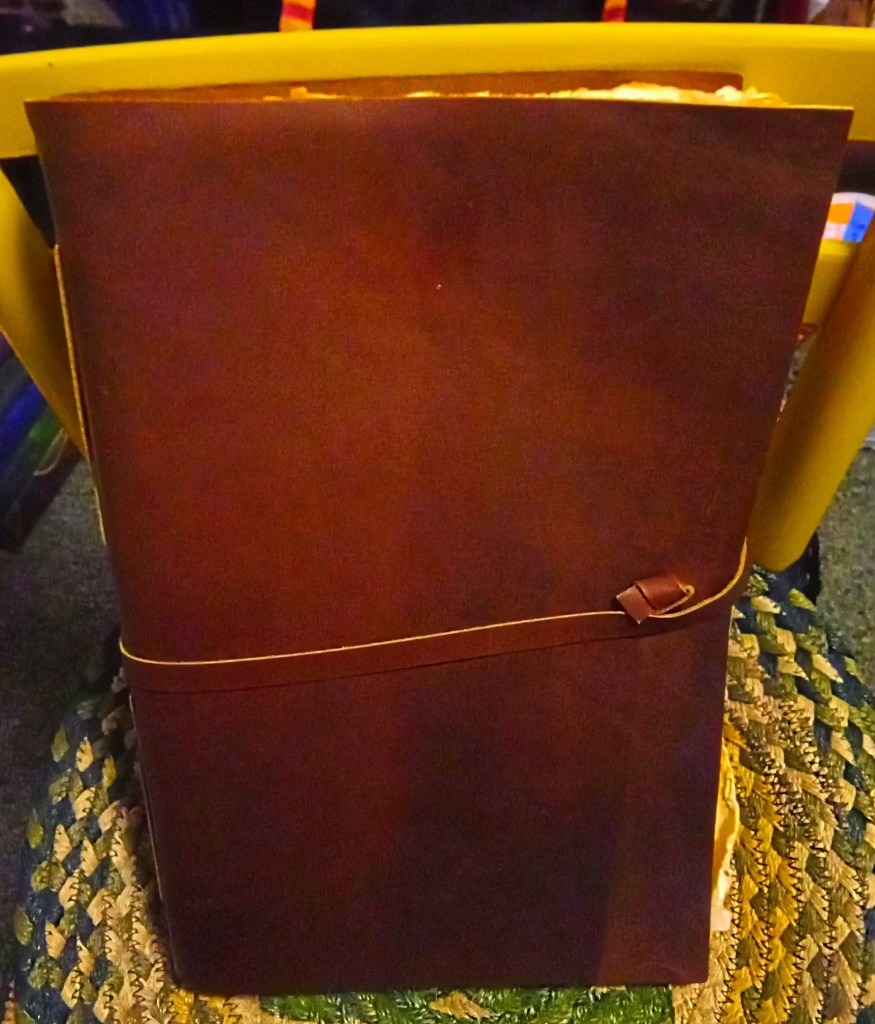
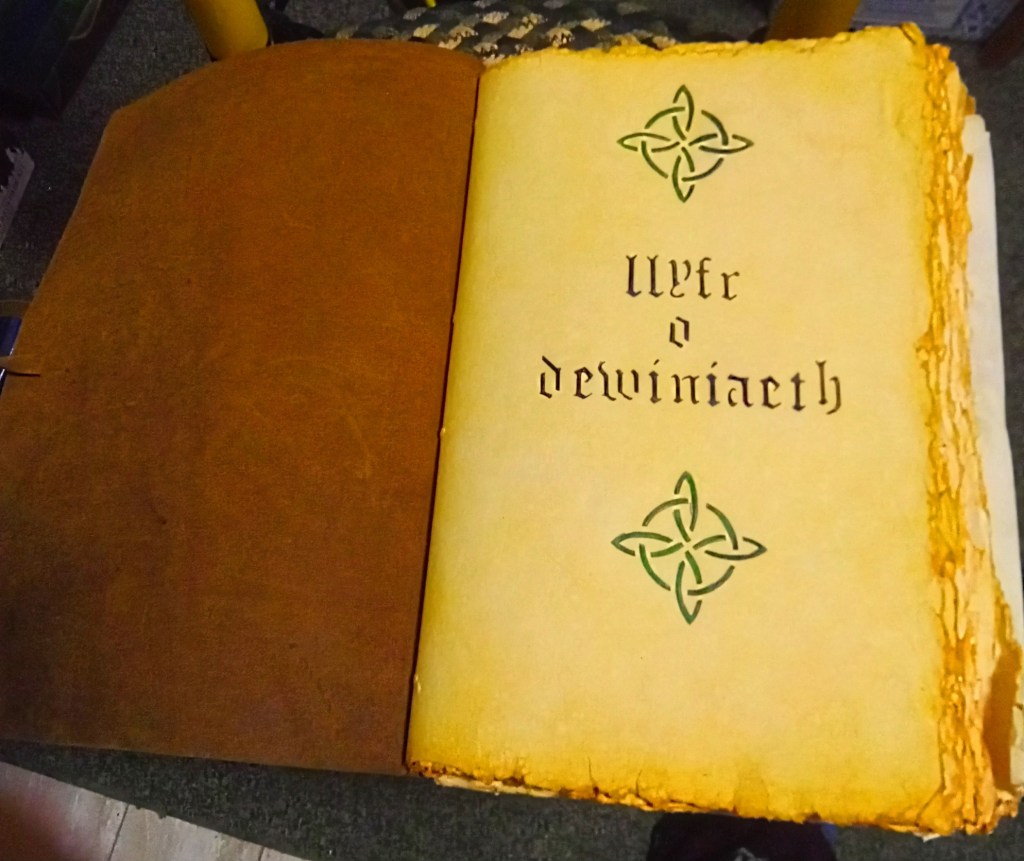
My own Book of Shadows, which I have named Llyfr o Dewiniaeth (Welsh for ‘Book of Magic’) is a large leather-bound book of parchment pages that have been given an antique appearance. I found this on Amazon, of all places. The pages are quite thick and suitable for writing, drawing or even painting on. It is a rare thing for me to share photos of my sacred book of magic, but here you only get to see the first page with it’s name. This book is one of my most prized possessions.

I want to emphasize again about not getting something too small. It is kind of a drag transferring everything from a smaller book into a larger one, and is very time-consuming. The larger ones are more expensive, but are well worth it in the long run. In my own book, I document the spells, rituals and magical information that I use most often, including information from books and teachers that have been most meaningful in my life and personal path. Do not just put random information in your book, but only that which has the most meaning for you and that which you will use on a regular basis. Your Book of Shadows, or whatever you choose to call it, is meant to be personal and an extension of your magical identity.

When Spells Don’t Work

Magic can be tricky, and there are some things that can make your spells ineffective. Take note of the following list when planning your magical workings.

  • Energy Failure: If energy is not raised properly or is not allowed to reach it’s peak, it is likely your spell will not manifest. Practice different forms of energy raising techniques, such as chanting, dancing or burning parchment with a written intention to discover which works best for you.
  • Doubt: If you do not believe in what you’re doing and you really don’t think it will work, then chances are it will not.
  • Unclear Intention: Know exactly what you want. Be specific. If you are indecisive or unclear, nothing will manifest for you. If you are not specific enough, you may get what you want, but with unpleasant strings attached.
  • Don’t Talk About It: Telling your friends or posting on social media about the spell you cast last night is a sure way of bringing that energy back to you and disabling your spell. Remain silent about your spellcasting. Skeptical friends or outsiders who have negative opinions about spells and magic can bring their harmful energy into the process. Your best bet is to be silent about your magical workings until they have manifested into physical reality.
  • Weak Will: If your will is not strong enough or if you’re really not sure it is what you want, this can also sabotage your spell. Be commanding and know that it is yours.
  • Lack of Follow-Up: If you cast a job spell but you don’t submit any resumes or go on interviews, you can’t expect to get that job. Follow up is important.
  • Scattered Correspondences: If the symbols and energies you use in your spell do not have any association to the outcome, there is a good chance your spell will not manifest. Like attracts like.
  • Mercury Retrograde: It is a matter of debate whether or not it is a good idea to do spellwork while Mercury is in retrograde. A good rule of thumb is, if it bothers you, then don’t do it. If you feel confident enough to cast your spell, and it cannot wait until Mercury goes direct, then cast it. Some practitioners include in their spell “I neutralize the power of Mercury in Retrograde“.
  • Lack of Full Attention: If you are distracted or in a hurry while casting your spell, then it is not likely to have the effects you want. Wait until you can be undisturbed and give the spell all of your attention and focus.
  • Violation of Free Will: This is a rather grey area, as these kinds of spells do work, but with repercussions. Magic that is used to control others or make them do something they would not otherwise do is a dangerous practice. The power of suggestion is real, however, the only way another person can use magic to violate another’s free will is if there is already a weakness or foothold in the area of suggestion. It is very important that those who work with magic constantly examine themselves, We must discipline our minds and work to take control of our fears, anxieties and passions. It is not an easy task.
  • Moon Phases and Planetary Energies: These can work against you if your spell is cast during unfavorable times. Be aware of current moon phases and planetary hours to get more power behind your spells.
  • True Will and the Plan of the Universe: There are times when we may cast a spell that is not for our highest good, and does not fit within the plan of the universe. There may in fact be something even better for us on the horizon, and a particular spell may not be aligned with our true will. It is important to include in our spells an intention of “for the highest good” and an outcome that is “perfect and correct”. It is equally important to focus on the outcome of your spell and not on how it manifests.

The casting of spells is an art and a science. There are many factors that come into play. This is not an exhaustive list of things that can wreck your spell, but they are some important ones. Plan your spells carefully.

Benefits of a Structured Practice

I have encountered many pagans who have a practice that seems rather chaotic and random, with no rhyme or reason, and approach it with a sort of casual “whatever I feel like today” attitude. There is no discipline or consistency to their practice. Many become “Eclectic” witches, because they don’t want to be limited to one particular system or pantheon. This buffet-style paganism seems to work for some, but leaves others feeling their energies scattered and ungrounded.

My practice has remained largely unchanged for the last ten years, but it is still just as vibrant and alive as ever, because it is based on connection and relationship. While it is very structured, it still allows room for growth. I will share my practice with you, and give suggestions on how to develop your own. In the meantime, consider the following:

  • What deity figures, gods and goddesses do you feel the strongest connection with?
  • Which crystals and stones do you use most often?
  • What flowers, herbs and plants, if any, are the most important to your personal practice?
  • Consider your magical skills. Perhaps you’re a tarot reader or a Reiki practitioner. Would you like to develop these skills further?

Below is a brief outline of my yearly practice. You will see that even though it has organization and structure, there is room for growth and versatility. I have strong connections to the Celtic current and it’s magical systems, so this is what I work with exclusively. You may choose to work with others of your choice. I present this only as an example, so that you can use it as a template for your own personal practice.

January

  • Deity: Cu Chulainn
  • Plant: Valerian
  • Stone: Citrine
  • Weekly Divinations
  • Rituals: Full Moon and New Moon
  • Reading and Study
  • Meditation

February

  • Deity: Brigid
  • Plant: Hyssop
  • Stone: Rose Quartz
  • Weekly Divinations
  • Rituals: Imbolc, Full Moon/New Moon
  • Make Brigid’s Cross for altar
  • Reading and Study (Tending Brigid’s Flame by Lunaea Weatherstone)
  • Meditation

March

  • Deities: Cerridwen and Taliesin
  • Plant: Blackthorn
  • Stone: Green Aventurine
  • Weekly Divinations
  • Rituals: Spring Equinox, Full Moon/New Moon
  • Crafting and Consecrating a New Wand
  • Reading and Study (Mabinogion, Cerridwen by Kristoffer Hughes)
  • Meditation

April

  • Deities: Dian Cehct and Airmid
  • Plant: Mandrake
  • Stone: Moonstone
  • Weekly Divinations
  • Rituals: Full Moon/New Moon
  • Reading and Study
  • Meditation

May

  • Deity: Cernunnos/Herne/Green Man
  • Plant: Sage
  • Stone: Clear Quartz
  • Weekly Divinations
  • Rituals: Beltane, Full Moon/New Moon
  • Make a new batch of Personal Oil
  • Reading and Study (Three Cauldrons of Poesy)
  • Meditation

June

  • Deity: Manaanan Mac Lir
  • Plant: Lavender
  • Stone: Amethyst
  • Weekly Divinations
  • Rituals: Summer Solstice, Full Moon/New Moon
  • Visit to Peace Valley Lavender Farm
  • Make a new Crane Bag
  • Astral Projection/Psychic Travel Exercise
  • Reading and Study
  • Meditation

July

  • Deity: Rhiannon
  • Plant: Marigold
  • Stone: Lapis Lazuli
  • Weekly Divinations
  • Rituals: Full Moon/New Moon
  • Reading and Study (The Song of Amergin)
  • Meditation

August

  • Deity: Lugh
  • Plant: Yarrow
  • Stone: Tree Agate
  • Weekly Divinations
  • Rituals: Lughnasadh, Full Moon/New Moon
  • Re-dedicate skills and abilities to Cerridwen and Community
  • Craft new Protection Amulets and Talismans
  • Dragon Magic
  • Reading and Study
  • Meditation

September

  • Deity: Mabon
  • Plant: Cinquefoil
  • Stone: Selenite
  • Weekly Divinations
  • Rituals: Autumn Equinox, Full Moon/New Moon
  • Reading and Study (Mabon story from The Mabinogion)
  • Meditation

October

  • Deity: Morrigan
  • Plant: Wormwood
  • Stone: Black Obsidian
  • Weekly Divinations
  • Rituals: Samhain, Full Moon/New Moon
  • Craft a new Ancestor Bottle
  • Craft a new batch of Ancestor Incense
  • Reading and Study (Celtic Lore and Spellcraft of the Dark Goddess, by Stephanie Woodfield)
  • Meditation

November

  • Deity: Dagda
  • Plant: Mugwort
  • Stone: Hematite
  • Weekly Divinations
  • Rituals: Full Moon/New Moon
  • Reading and Study
  • Meditations

December

  • Deity: Cailleach
  • Plant: Mistletoe
  • Stone: Snowflake Obsidian
  • Weekly Divinations
  • Rituals: Winter Solstice, Full Moon/New Moon
  • Craft a new Silver Branch
  • Reading and Study
  • Meditations

This is not an exhaustive list of everything I do each month, there are other more specific things I could have added, but I did not want to make it too confusing. As you can see, there is room to be flexible on various things, such as study material or forms of divination. I typically use tarot, oracles, pendulum and crystal ball. I practice various forms of meditation, including chant and creative visualization. There are certain things I do at specific times of the year, such as wand making in the spring and protection talismans in the summer. Add practices that are meaningful to you in your own yearly devotionals.

By working with the same deities, plants and stones on a consistent basis, you develop a stronger connection to them. You can use this same format to choose which of these you will focus on each month. Many people have one specific deity they are closest to, and for me that is Cerridwen. I acknowledge her in all of my rituals and her statue is on my altar year round, but there are other deities I draw near to each month as well. It is my hope that sharing my yearly practice will help others develop their own. You will find that a structured practice such as this will be more meaningful than one that is scattered and disorganized. After all, you will be working with the deities, plants and stones that you have the strongest connection to, and learning more about them each month. Discipline and consistency are key elements to developing strong relationships with our magical allies.

The Lost Art of Tree Gazing

Divination by leaves and branches of trees, called Dendromancy, relies heavily on intuition and the inner voice. By observing the whispers of leaves, and the swaying of branches in the wind, the trees offer their wisdom for our personal growth. When tree gazing, it is best to approach them with open-ended questions rather than seeking a “yes-or-no” answer. Scientific studies suggest that trees communicate with each other through root systems and fungi under the earth, and through the air using pheromones and other chemicals. With a world-wide network of trees, many that are thousands of years old, they are believed to have developed a language of their own. They can also communicate with humans who have learned to listen.

Whenever a witch places their hands on a tree with the intention of healing and communication, the tree responds accordingly. An old word for witch is Pharmaceute, where we get the word pharmacist. This word denotes the witch as someone knowledgeable in the healing properties of flowers, plants and trees. The trees will nearly always recognize a pharmaceute, for they know you mean them no harm and your intentions are for the highest good. When tree gazing during the light half of the year (spring and summer), observe the sound and movements of the leaves and branches. During the dark half of the year, (fall and winter), observe the bare branches as they dance in the wind. You will find the energy feels different at different times of the year.

To begin tree gazing, you must first find the tree you wish to communicate with. You may have a favorite tree already, or you may wish to find a tree at a local park. Intuitively listen as you walk among the trees until you find one that “feels” friendly and receptive. Find a spot where can sit undisturbed near the tree for at least half an hour.

Next, close your eyes and take several deep breaths until you reach a meditative state. This will help make you more receptive to receive psychic information. Place your hands on the tree, and visualize white light coming out of your hands and into the tree. See the entire tree bathed in this healing white light. Project feelings of love and healing into it. Say to the tree, “Blessed tree, I come to seek your wisdom”, or “I seek your wisdom about...” then state your problem or issue. At this point you may keep your hands on the tree, or if you’re worried about getting looks from passers-by, sit as near to the tree as possible so you can observe it. Just as with most types of divination, the tree will impart information through impressions, images or feelings. Have a notepad and pen handy to jot down anything that comes to you. Do not stare at the tree, but let your gaze soften as you maintain an open, meditative state of mind. There are many things to take notice of as you observe the tree, such as:

  • What shapes or symbols do you see formed by the branches or leaves?
  • Are there any sounds coming from the tree? If the wind is blowing through the leaves, close your eyes and listen closely. What does the tree seem to be saying? Take note of your emotions. What are you feeling?
  • Is there any wildlife in or around the tree? Birds, insects and other animals all have their own unique wisdom. A bird building a nest could indicate that it’s time for you to start preparing for the future. Write down the animals see so you can explore their wisdom further at a later time.
  • Are there any plants growing on or near the tree? Mistletoe growing on an oak tree could suggest that you need to devote more time to spiritual practice. Write down all of the plants you see, and research their magical properties.
  • Is the tree near a body of water? If there are long branches extended over the water, take note of how it is reflected in the water below.

It is important not to be super-specific when tree gazing, as their wisdom seems to be more focused on personal growth and inner transformation, rather than “should I take this job” sort of questions. It may take some practice, but as the tree becomes more comfortable with you it will communicate more often. It is also good to know what kind of tree it is and any magical associations it may have. Consider the tree a friend, and it will respond in kind.

At the end of your tree gazing session, always leave it a gift. You can pour some spring water around it’s base, or leave some seeds, fertilizer or stones (Tree Agate, Clear Quarts or Aventurine are good choices). Thank the tree for sharing with you, and document your experience in a journal.